AI for Fashion Businesses in Australia: What Claude Can Do and Where to Start
10 Minute ReadSomething has shifted in the conversations I am having with fashion founders and leadership teams.
Not dramatically. Not all at once.
But quietly and consistently, AI is entering the room.
Not as a topic to debate. As a tool people are starting to use.
And the question is no longer whether AI is relevant to fashion businesses in Australia.
It is whether you are using it well.
Author: Elizabeth Formosa | Fashion Business Consultant | May 2026
This month, I am dedicating the entire Monthly Edit to one subject.
CLAUDE
Specifically, what it is, why it matters for fashion retail, brand and eCommerce businesses, and where it can genuinely support the way you work.
This is not a technology piece. It is a commercial one.
Because at its core, AI is a productivity and clarity tool. And clarity is exactly what growing fashion businesses need more of.
What Is Claude and Why Does It Matter for Fashion Brands?
Claude is an AI assistant built by Anthropic.
Like ChatGPT, it is a large language model. You type a question, a brief, a request in plain English, and it responds with coherent, considered output.
No coding required. No technical knowledge needed. Just clear thinking on your part, and clear instruction to the tool.
I have been working with Claude specifically because of how it handles nuance and complexity.
It does not just generate output. It thinks through context.
For the kind of strategic and operational work that fashion businesses do every day, across leadership, product, planning, marketing, and finance, that distinction matters.
Why Australian Fashion Businesses Need to Pay Attention Now
Fashion businesses at the scaling stage are managing more complexity with the same, or smaller, teams.
More channels. More decisions. More stakeholders. More content. More planning cycles.
For Australian fashion brands operating across retail, wholesale, and eCommerce, the operational load is significant. And the margin for inefficiency is shrinking.
AI does not replace the thinking. But it can significantly reduce the time it takes to get from thinking to doing.
That is where the value lives.
Not in novelty. In operational leverage.
How Fashion Equipped Approaches AI Advisory
Before I share where Claude can support your business, I want to be transparent about how we have arrived at this conversation.
At Fashion Equipped, we do not adopt tools lightly.
We have spent considerable time evaluating AI platforms, sitting in product demos, building and testing our own tech stack, and assessing how different tools perform across real fashion business workflows.
Our starting point is always the same.
Understand the workflow first. Then identify where AI can genuinely improve it.
This is not a small distinction.
There is a growing number of voices speaking about AI in fashion who understand the technology deeply but have limited experience of how fashion businesses actually operate. The complexity of managing financials across retail, eCommerce, and wholesale channels, from sales and cost of goods through to operational expenses, profitability, and cash flow. The reality of building and executing a dynamic marketing strategy in one of the most competitive retail landscapes we have ever seen, where the volume and consistency of content required to power that strategy has never been greater. The challenge of managing product, inventory, and supplier relationships across multiple channels and seasons simultaneously. The discipline of making commercially sound decisions under pressure, with incomplete information and competing priorities.
Our perspective comes from the opposite direction.
Over two decades of working inside and alongside fashion businesses, across senior leadership, brand, product development, buying, sourcing, wholesale, eCommerce and strategic consulting, means we understand the workflows before we evaluate the tools.
That is the lens through which everything that follows has been assessed.
Workflow first. AI second.
Six Areas Where AI Can Support Your Fashion Business
What follows is not a definitive list. It is a starting point.
Six areas where we are seeing genuine, practical value for scaling fashion brands in Australia.

1. Business Leadership and Founder Productivity
The founder or business leader is where the pressure concentrates.
Strategic decisions. Team management. Stakeholder communication. Planning cycles. The constant movement between operational detail and high-level thinking. The mental load is significant, and it rarely lets up.
This is where Claude can make an immediate and tangible difference.
At the day-to-day level, use it to draft meeting agendas, capture and structure meeting notes, and turn a raw conversation into a clear set of actions and owners. Use it to draft team communications, prepare briefs, and handle the repeatable writing tasks that quietly consume hours across the week.
At a more strategic level, Claude becomes a thinking partner.
Use it to structure a presentation before you build it. To think through a difficult decision by laying out the options, the risks, and the implications clearly before you act. To synthesise data or research from multiple sources into a coherent summary you can actually use. To prepare for a difficult conversation by working through the key points and likely responses in advance.
The goal is not to hand thinking over to AI. It is to use it to think more clearly, move more efficiently, and spend your energy where it matters most.
A prompt that works: "Here are my rough notes from this morning's leadership meeting. Summarise the key decisions, list the action items with owners, and draft a follow-up message I can send to the team."

2. Financial Visibility and Reporting
Many founders have the data. What they lack is the structure to surface it quickly and the language to communicate it clearly to their team, their leadership group, or their investors.
Most founders can tell you their revenue. Far fewer can tell you their net margin by channel on a Tuesday morning. That gap is where commercial discipline either forms or falls apart.
Claude can help you build that structure.
Use it to design a weekly trading dashboard, defining the metrics that matter most for a multichannel fashion business and the narrative framework for reviewing performance consistently.
Key metrics to track include sales by channel versus budget, sell-through, gross margin, operational expenses, net margin, inventory cover, and intake versus plan. Reviewing these consistently, in a format that prompts the right questions each week, creates the commercial discipline that separates intentional brands from reactive ones.
Claude can also support scenario-based modelling during difficult trading periods. If sales are tracking behind plan, use it to think through sales tactics and strategic options, stress-test assumptions, and structure your response before you act.
Claude will not connect to your systems or pull your numbers automatically. But it will help you design the reporting architecture, draft the commentary, and translate your data into clear, decision-ready language.
A prompt that works:"Help me design a weekly trading dashboard for a multichannel fashion brand. Include key metrics across sales versus budget by channel, sell-through by category, gross margin, net margin, and inventory cover. Present it as a simple template with weekly commentary prompts."

3. Product Strategy and Development
Product is the engine of every fashion business. Getting the strategy right, and communicating it clearly, is one of the most demanding and time-consuming parts of the role.
Claude can support across the full product development cycle.
Use it to build and pressure-test your range plan, working through range hierarchy, collection balance, and how each category earns its place in the assortment. It can help you think through price tiering and pricing architecture to ensure the range is commercially optimised before you commit to buys. It can assist with margin analysis at the range planning stage, so you are making intentional decisions backed by data, rather than intuitive or reactive ones.
Beyond planning, Claude can help you draft detailed supplier briefs, structure internal product strategy documents, and synthesise feedback from the market into clear, actionable direction.
It will not replace your creative eye or your commercial judgment. But it will help you move faster, communicate more clearly, and spend less time on the document work that slows the process down.
A prompt that works: "Here are my notes from our range planning session. Help me structure a range hierarchy across our core categories, identify any gaps in our pricing architecture, and draft a brief I can share with the team."

4. Merchandise Planning
Merchandise planning is one of the most demanding disciplines in a fashion business.
It requires structured thinking, clear communication across the business, and the ability to translate data into forward decisions.
Claude can support the full planning cycle.
Start with past season analysis, reviewing sales and sell-through across categories, assessing what was bought versus what sold through, and identifying where inventory decisions worked and where they did not. This analysis then becomes the foundation for your forward season planning framework, across core categories, any new categories entering the range, and the OTB plan that underpins it all.
From there, Claude can help you build out your buying plan and structure order placement across supply chain partners. It can assist with analysis across sizes, colours, and SKUs to support more precise inventory decisions. And it can help you prepare a pre-season merchandise plan presentation for leadership or across departments, translating the numbers into a clear, confident narrative.
For businesses that are not yet at the scale or budget for an enterprise merchandise planning platform, Claude offers a practical and accessible way to bring more structure and rigour to the planning process.
A prompt that works: "I am preparing for our pre-season planning review. Help me structure a past season analysis across our key categories covering sales, sell-through, and buy versus sold. Then help me build a forward planning framework for the new season including OTB by category."

5. Marketing and Content
Scaling fashion brands need to operate as content machines.
The volume of marketing output required across channels has never been higher, and the brands that do it well are the ones that have built the systems and frameworks to support consistent, on-brand output without burning out their teams.
Claude can help you build those systems.
Use it to map out a twelve month marketing and promotional calendar, aligning campaign moments with your trading plan and seasonal cadence. It can draft social captions and email campaigns, write influencer briefs, and help you develop copy across channels consistently and efficiently.
Beyond content creation, Claude can support performance analysis. Use it to review analytics across organic social and paid performance marketing, identifying what is working and where to focus. It can analyse the content performance of competitor or aspirational brands in your market, and use those insights to develop your own content briefs.
This combination of creation and analysis is where AI starts to add genuine strategic value to a marketing function.
A prompt that works: "Review these content performance notes from our last campaign. Identify what worked, what did not, and draft a content brief for our next campaign based on those insights. Channels: email, Instagram, paid social. Brand voice: [describe it]."

6. Trend and Market Intelligence
Staying across trend, competitor dynamics, and market shifts is important for every fashion business. It is also one of the first things that gets deprioritised when a team is stretched.
Claude can support this in a specific and practical way.
It can synthesise information you bring to it, whether that is trend reports, eCommerce industry data, competitor observations, or customer sentiment research, and help you extract the strategic implications for your business.
This is particularly valuable right now, when Australian consumers are under cost-of-living pressure, discretionary spending is being scrutinised, and competitor positioning is shifting in response. Understanding price shifts, brand repositioning, and market dynamics across your competitive set is critical intelligence for navigating your own brand forward.
Use Claude to structure market intelligence briefings and trend briefings for relevant teams. Bring the raw information, and let it help you synthesise, prioritise, and communicate clearly.
This is not AI predicting trends. It is AI helping you think through and communicate the intelligence you already have, more efficiently.
A prompt that works:"Here is a summary of the latest Australian eCommerce industry data and my observations on competitor positioning this season. Help me extract the three most commercially relevant implications for our business and structure this into a market intelligence briefing for the team."
Join the Mailing List to receive the “Monthly Edit” direct to your inbox.
Plus access subscriber-only free industry reports
What AI Cannot Do for Your Fashion Business
It is worth being direct about this.
Claude is not a strategist. It does not know your business. It will not replace experienced people or considered commercial judgment.
The quality of what it produces is directly connected to the quality of what you give it.
Think of it as a highly capable colleague who is new to your business. Brilliant at structure, language, and synthesis. But entirely dependent on the context and direction you provide.
A practical example: if you ask Claude to draft a supplier brief without giving it context about your brand positioning, your product strategy, your target costs or your relationship with that supplier, the output will be quite generic. Usable as a starting point, but not commercially focused. The founders and brand leaders who get the most from AI are the ones who bring the most to it. Deep context. Clear direction. Commercial judgment applied to every output before it leaves the room.
The more specific you are, the more useful it becomes.
And the more deeply you understand your own workflows, what information flows where, what decisions need to be made, where communication is breaking down, the more precisely you can deploy it.
Which is exactly why workflow understanding has to come before AI adoption.
The Strategic Opportunity for Fashion Brands in 2026
There is no shortage of people telling fashion businesses that AI will change everything.
That may be true. But it is not the most useful place to start
Here is what I am interested in: Australian fashion businesses that are scaling are already stretched. Founders and brand leaders are carrying significant decision load. Teams are moving fast. Documents get produced under time pressure. Communication is constant and often inconsistent.
Used with intention and specificity, with experienced judgment applied to every output, AI frees up cognitive space.
And cognitive space is where good decisions are made.
For fashion brands operating between one and ten million dollars and beyond, this is not a small advantage. It compounds.

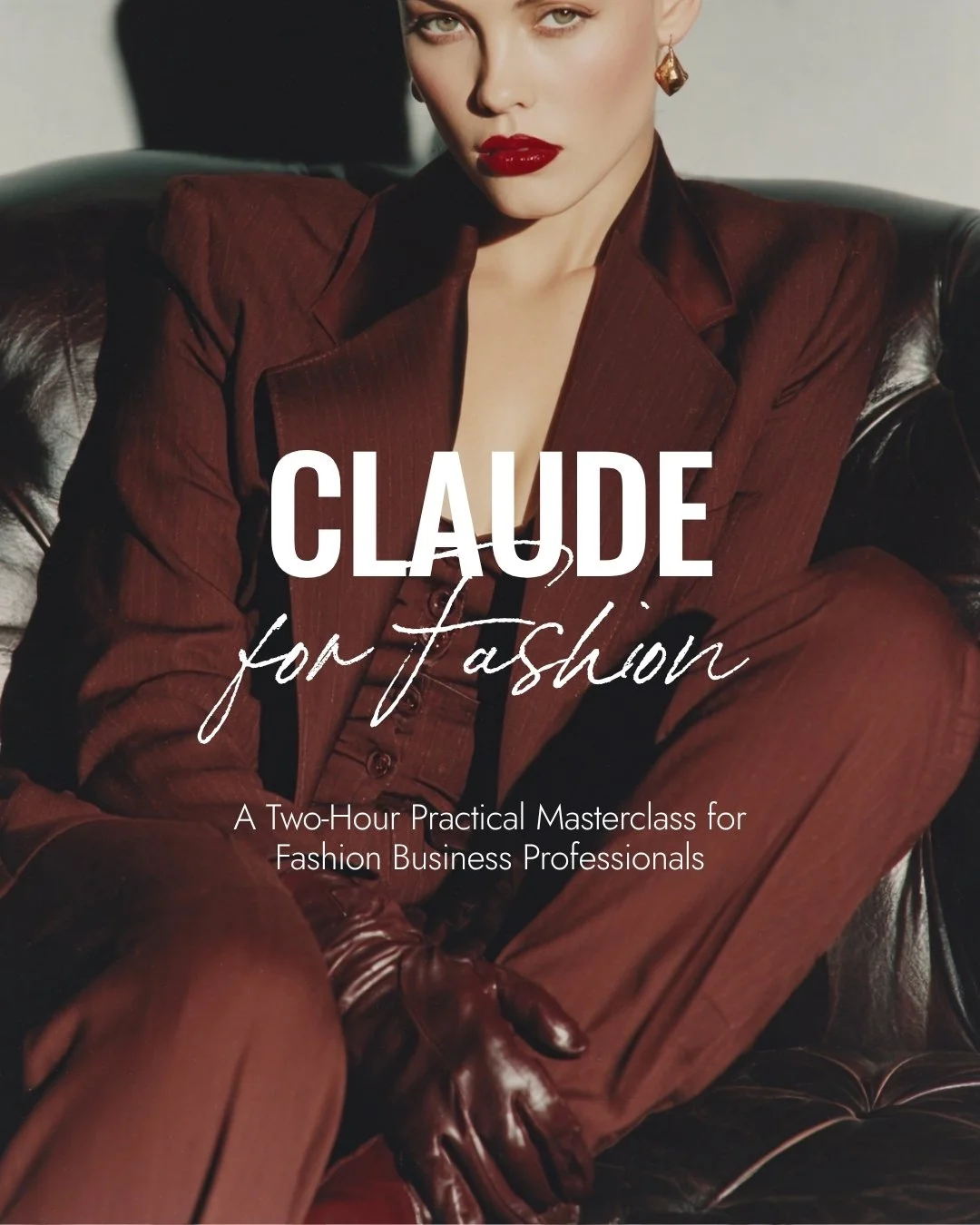
Register Now: Claude for Fashion Masterclass
This edition is an introduction.
What is coming next is a dedicated, practical masterclass, Claude for Fashion, designed specifically for fashion founders, buying teams, brand leaders, and operators across retail, wholesale, and eCommerce who want to integrate AI into their workflow with intention and commercial clarity.
Not a generic AI overview. A fashion-specific, workflow-grounded session built on real industry experience.
Tuesday 21st July, 1 pm - 3 pm AEST.
Strategic Questions to Ask Yourself This Month
As you consider where AI might fit in your fashion business, start here.
Where are you losing time to tasks that could be systematised? Where is communication across your team inconsistent or slow? Where are documents being produced under pressure that could be drafted faster? Where do you lack the reporting structure to make confident decisions quickly? Where is your leadership thinking being crowded out by operational noise?
These are the starting points.
Not the technology. The friction.
Find the friction first. Then explore whether AI can reduce it.

The goal is not to adopt every new tool.
It is to build a fashion business that is structured, clear, and capable of sustained commercial performance.
AI, used well and understood deeply, supports that.
Here is to building fashion businesses that are not just keeping up. But thinking ahead.
Elizabeth
— Elizabeth Formosa, Founder and Strategic Advisor, Fashion Equipped
A note on what is coming.
This edition covers Claude as a productivity and strategic tool. But the Claude ecosystem extends well beyond what we have covered here.
Claude Design is a research preview tool from Anthropic that allows you to build prototypes, slide decks, and branded design systems directly within Claude. And Claude Cowork is an early-stage product from Anthropic that aims to connect Claude to your email, calendar, and day-to-day tools. We are watching its development closely.
The applications for fashion businesses are significant.
We are actively exploring both and will be covering them in future editions and as part of the Claude for Fashion workshop series.
Watch this space.
Ready to explore how AI could support your fashion business workflow? Join the waitlist for the Claude for Fashion workshop above.
Want to strengthen the strategic and commercial foundations of your business right now? Explore how you can work directly with Elizabeth.
The Latest on Fashion Business Mindset Podcast